Leopold Hertzberger
Leopold Hertzberger was a classmate of Margot Frank at the Jewish Lyceum.
Person
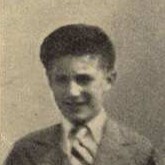
Leopold (Leo) Hertzberger was a son of Emanuel (Menno) Hertzberger (1897-1982) and Klara Spanjer (1895-1942).[1] His father was a publisher, bookseller, antiquarian, co-founder and first president of the Nederlandsche Vereeniging van Antiquaren, or NVvA (Dutch Association of Antiquarians),[2] and secretary of the Jewish Historical Museum from 1930 to 1942.[3] Menno Hertzberger was born in Sneek, the son of Dr Leopold Hertzberger (1871-1933), a well-known physician, philanthropist and bibliophile. In May 1923, Menno opened his International Antiquarian bookshop in Amsterdam. On 23 January of the same year, he and Klara Spanjer were married in London. Klara had been born in Britain but had the Dutch nationality.[4] On 1 June 1924, their son Leopold was born.[1] They then had a daughter, Sarah (1926-1942), and another son, Philip Ivan (1928-1942).[5] Menno and Klara divorced on 15 August 1942.[4]
All three children of the Hertzberger couple were students at the Amsterdam Lyceum, but because Jewish students and teachers were banned from attending regular schools from 1 September 1941, they had to transfer to the Jewish Lyceum in Amsterdam.[6] Leo was in class 4B2, which also included Margot Frank,[7] his sister Sarah was in class 3L[8] and his brother Philip was in class 2L.[9] An assessment by his teachers, dated 25 February 1942, shows that he performed poorly and showed little interest. At the Amsterdam Lyceum, he had been held back in the first grade. Maths teacher Aäron Keesing noted: 'Absolutely cannot keep up in the 4th grade, and would probably not be able to keep up in the 3rd grade either."[10] His sister Sarah also received a poor assessment.[11]
A month after his parents' divorce, Leo, his mother and his younger sister and brother were rounded up and they ended up in Westerbork on 29 September 1942.[12] Leo's father, according to his card in the Jewish Council's card catalogue, had a Sperre because of his position as an adviser on economic issues and the Arbeitseinzsatz.[13] And, although expelled as a member of the NVvA, he was able to continue his bookshop until almost the end of the war, with the help of a benevolent Verwalter, without ever having to wear a star. He only had to go into hiding for a few months.[14]
His ex-wife and three children were deported to Auschwitz on 2 October 1942, where Klara, Sarah and Philip were murdered immediately upon arrival on 5 October 1942.[15] The train stopped on the way in Koźle (German: Kosel or Cosel), about eighty kilometres before Auschwitz. Leo and other boys and men aged between about fifteen and fifty were forced to get off the train there. They were put to work in labour camps for Jewish forced labourers in the area, Aussenkommandos of Auschwitz. Leo was transferred to Schöppinitz,[16] where he died on 31 October 1943.[17]
After the war, Leo's father married three more times and had three sons. On the occasion of his 65th birthday, he established the Menno Hertzberger Prize. This is a Dutch prize awarded since 1963 to persons of significance in the field of book history and the practice of bibliography.[18]
Source personal data.[1] Addresses: Van Breestraat 133, Amsterdam;[19] Bernard Zweerskade 20-II.[1]
Footnotes
- a, b, c, d Stadsarchief Amsterdam (SAA), Dienst Bevolkingsregister, Archiefkaarten (toegangsnummer 30238): Archiefkaart Leopold Hertzberger.
- ^ SAA, Dienst Bevolkingsregister, Archiefkaarten (toegangsnummer 30238): Archiefkaart Emanuel Hertzberger; Wikipedia: Menno Hertzberger.
- ^ Antiquaar Menno Hertzberger in Baarn overleden, NRC, 1 mei 1982.
- a, b SAA, Dienst Bevolkingsregister, Archiefkaarten (toegangsnummer 30238): Archiefkaarten Emanuel Hertzberger en Klara Spanjer.
- ^ SAA, Dienst Bevolkingsregister, Archiefkaarten (toegangsnummer 30238): Archiefkaarten Sarah Hertzberger en Philip Ivan Hertzberger.
- ^ SAA, 902 Archief van Het Amsterdams Lyceum: 3361 Hertzberger, Leo (01-06-1924); 3362 Hertzberger, Philip (15-09-1928); 3364 Hertzberger, Serah (01-04-1926); Joods Monument: Leopold Hertzberger; Philip Ivan Hertzberger; Sarah Hertzberger.
- ^ NIOD Instituut voor Oorlogs-, Holocaust en Genocidestudies, Amsterdam, W.S.H. Elte (toegang 181e), inv. nr. 2f: Absentenregister klas 4BII Joods Lyceum, 1 maart – 17 juli 1942; Dienke Hondius, Absent: herinneringen aan het Joods Lyceum Amsterdam, 1941-1943, Amsterdam: Vassallucci, 2001, p. 282.
- ^ Hondius, Absent, p. 280.
- ^ Hondius, Absent, p. 272.
- ^ NIOD, Joodsche Raad voor Amsterdam (toegang 182), Afdeling Onderwijs, Inrichting voor Voortgezet Onderwijs; Beoordelingen en opmerkingen van leraren inzake leerlingen, januari-juni 1942, Leerling Leo Herzberger, IVB2, 25 februari 1942.
- ^ NIOD, Joodsche Raad voor Amsterdam (toegang 182), Afdeling Onderwijs, Inrichting voor Voortgezet Onderwijs; Beoordelingen en opmerkingen van leraren inzake leerlingen, januari-juni 1942, Leerling Serah Herzberger, IIIL, 25 februari 1942.
- ^ Arolsen Archives - International Center on Nazi Perscuction, Bad Arolsen, Joodsche Raad Cartotheek: DocID: 130305485 (Klara HERTZBERGER SPANJER); DocID: 130305488 (Leopold HERTZBERGER); DocID: 130305495 (Philip VAN HERTZBERGER); DocID: 130305503 (Sarah HERTZBERGER).
- ^ Arolsen Archives, Joodsche Raad Cartotheek: DocID: 130305475 (Emanuel HERTZBERGER).
- ^ Hub. Hubben, Lege bladzijde, de Volkskrant, 12 september 1997 (bespreking van P.J. Buijnsters, Het Nederlandse antiquariaat tijdens de Tweede Wereldoorlog, Amsterdam: De Buitenkant, 1997).
- ^ Arolsen Archives, DocID: 5149563; DocID: 5149562; DocID: 5149561; C.P. Gunning, Gedenkboek 1940-1945 van het Amsterdams Lyceum, Uitgeverij Doorgeven, Amsterdam, 1947.
- ^ Joods Monument: Werkkamp Schöppinitz.
- ^ Arolsen Archives, DocID: 5149561.
- ^ Wikipedia: Menno Hertzbergerprijs.
- ^ Joods Amsterdam: Van Breestraat.