Bram Asscher
Bram Asscher was a classmate of Margot Frank at the Jewish Lyceum, Amsterdam. He wrote a letter from camp Westerbork to his mother in which he mentions seeing Margot and her family.
Person

Abraham (Bram) Asscher was a son of Eliazer Asscher (1878-1935) and Stephanie Fischer (1895-unknown).[1] His father was a diamond merchant and a brother of Abraham Asscher, one of the two presidents of the Jewish Council. Of three children, Bram was the middle child. He had an older brother, Isaäc Jacques Asscher (1916), and a younger one, Jacob (Jeannot, Jean) Asscher (1925).[2]
In school year 1941-42, Bram was a classmate of Margot Frank in class 4B2 at the Jewish Lyceum, Amsterdam.[3] In school year 1942-'43 he was in class 4B and in early September 1943 he was even enlisted for the fifth grade.[4] But that was no to be.
Together with his brother Jacob (Jeannot, Jean; 1925-1994), he was in camp Westerbork from 29 September 1943 to 13 September 1944.[5] Although he was not in the penal barracks, during this period he saw Margot and her family in the camp and wrote about it to his mother.
After the death of Bram's father in 1935 at the age of 57 in Paris, his mother married Dirk Leendert Tollenaar, a Gentile, in March 1941.[6] As a result, she had a Sperre — an exemption from deportation — as a mixed marriage. Her sons, however, as children of two Jewish parents, did not have this protection. Together with his brother Jeannot, Bram was transported to the Westerbork transit camp on 29 September 1943. On 13 September 1944 he was deported as part of the 'diamond group' to the Sternlager of Bergen-Belsen concentration camp. Both brothers survived the camps and were liberated in Hillesleben in May 1945.[5]
Eldest brother Jacques was an Engelandvaarder, someone who after the capitulation of the Dutch armed forces left the occupied territories of the Netherlands with the intention of reaching England in order to join the Allied Forces and to continue the struggle against the Axis powers.[7] In April 1941, Jacques left by train for Brussels and travelled via Paris to Spain, then Portugal, from where he flew to New York. After being approved for military service, he embarked in Canada aboard SS Queen Elizabeth and arrived in Scotland in December 1942.[8]
Letters from Westerbork
Bram was in Westerbork in the 'free' camp section. He was allowed to write a letter or two every fourteen days and to receive parcels. On 25 August 1944, Bram wrote to his mother from Westerbork that Margot, Anne and their parents had been locked up in the punishment barracks in camp Westerbork: 'Mama, do you know that Margot is here? That friend of Trees. You remember her, don't you? She's in the S with her parents and sister. Very sad!' Bram also thanked his mother in the letter for the beautiful toothbrush and other items.[9] This letter is one of the few personal sources which refer to the presence of the Frank family in Westerbork.
In his letters from Westerbork, Bram often writes about his fiancee Trees lek, who was held captive in Camp Vught together with her two sisters, and her parents, who were with him in Westerbork.[10] According to unconfirmed reports, he married Trees.[11] However, this is not registered on her personal card in the population register.[12] That they already had something going on at school is suggested by an entry in Anne's diary, where she writes that one evening in the bathroom she and Margot were talking "about Bram and Trees."[13]
Source personal data.[1] Addresses: Beethovenstraat 122 II, Amsterdam (’36); Stadionkade 41 hs (’41);[1] Ericalaan 197, Den Haag.[14]
Footnotes
- a, b, c Stadsarchief Amsterdam (SAA), Dienst Bevolkingsregister, Archiefkaarten (toegangsnummer 30238): Archiefkaart Stephanie Fischer.
- ^ Akevoth: Family page, Eliazer Asscher, alias: Elie. Daar staat ten onrechte dat Jacob in 1945 in Bergen-Belsen is gestorven; hij overleed op 23 november 1994 in Parijs. Familiebericht, De Telegraaf, 30 november 1994.
- ^ NIOD Instituut voor Oorlogs-, Holocaust en Genocidestudies, Amsterdam, W.S.H. Elte (toegang 181e), inv. nr. 2f: Absentenregister klas 4BII Joods Lyceum, 1 maart – 17 juli 1942; Dienke Hondius, Absent: herinneringen aan het Joods Lyceum Amsterdam, 1941-1943, Amsterdam: Vassallucci, 2001, p. 281.
- ^ NIOD Instituut voor Oorlogs-, Holocaust en Genocidestudies, Amsterdam, Archief 181e (W.S.H. Elte), inv. nr. 2f, Correspondentie met de afdeling Onderwijs van de Joodsche Raad en andere instanties over onder meer de inschrijving van leerlingen en de aanstelling van leraren, 19 december 1941 - 7 september 1943: A. Robles aan W.S.H. Elte, 3 september 1943.
- a, b Joodse Raad kaart Abraham Asscher, Document ID: 130252763, Arolsen Archives.
- ^ SAA,Dienst Bevolkingsregister, Archiefkaarten (toegangsnummer 30238): Archiefkaart Dirk Leendert Tollenaar.
- ^ Wikipedia: Engelandvaarder.
- ^ Nationaal Archief, Den Haag, Engelandvaarders, 1940-1945, Reizen van Engelandvaarders, Achternaam: Asscher.
- ^ Kamp Westerbork Digitale Collectie, RA 1090, Bram Asscher aan familie D.L. Tollenaar, 24 augustus 1944. Zie ook: Eva Moraal, Als ik morgen niet op transport ga... Kamp Westerbork in beleving en herinnering, Amsterdam: De Bezige Bij, 2014, p. 363.
- ^ Kamp Westerbork Digitale Collectie, Correspondentie van Bram Asscher met D.L. Tollenaar, 20 november 1943 - 22 mei 1945.
- ^ E-mail van Dienke Hondius, 26 februari 2012. Dienke heeft de informatie van Ina Polak.
- ^ SAA,Dienst Bevolkingsregister, Archiefkaarten (toegangsnummer 30238): Archiefkaart Treesje Evelijn Lek.
- ^ Anne Frank, Diary Version A, 23 March 1944, in: Anne Frank, The Collected Works, transl. from the Dutch by Susan Massotty. - London [etc.]: Bloomsbury Continuum, 2019.
- ^ Familiebericht, De Telegraaf, 30 november 1994.
Digital files (1)
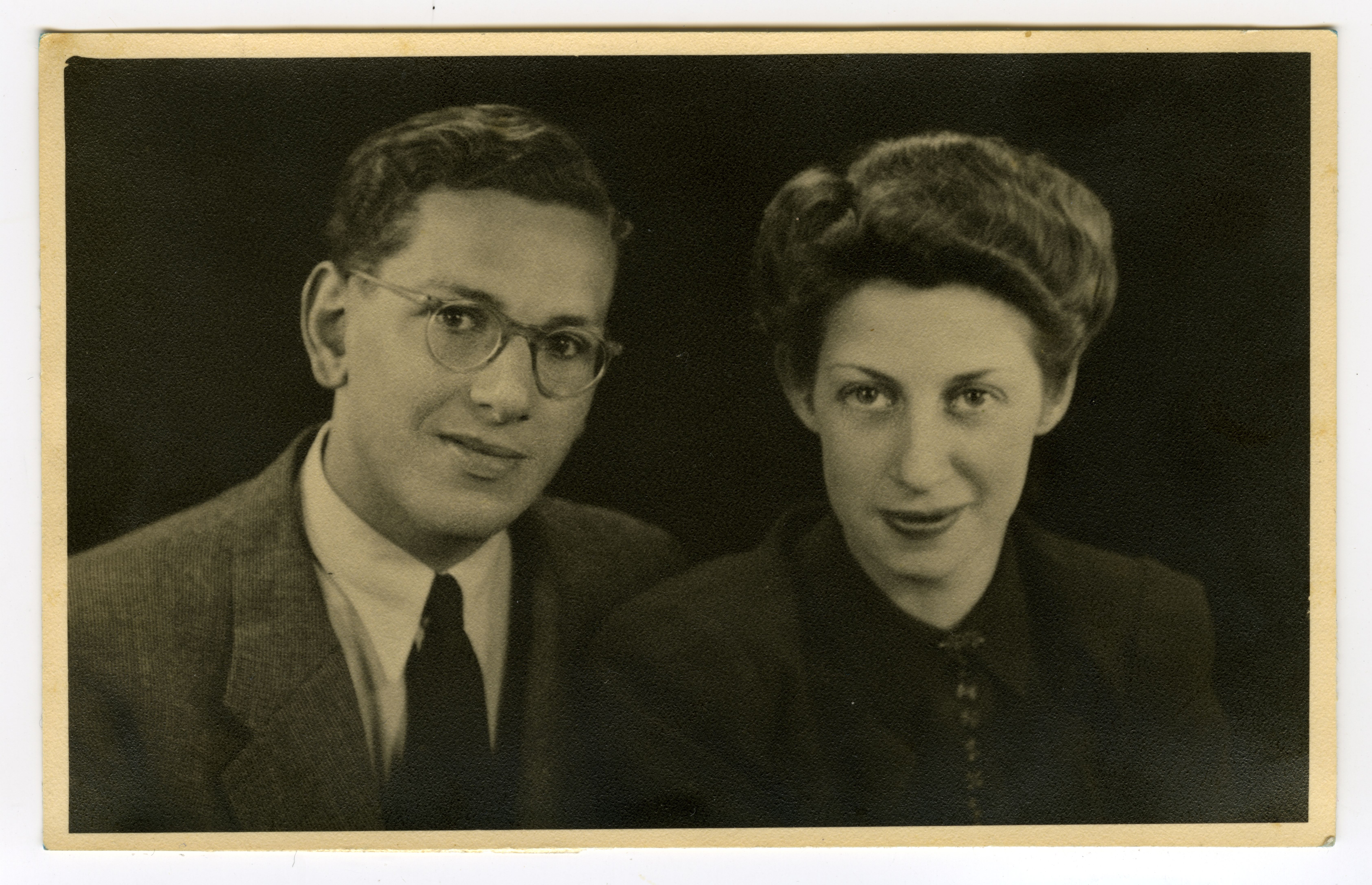
Bram Asscher en Trees Lek, kort na de oorlog
Copyright: Rechthebbende(n) onvindbaar
Photographer: De collectie kan worden ingezet voor het publiek