Annie Romein - Verschoor
Annie Romein helped Otto Frank find a publisher for the diary of his daughter Anne.
Person
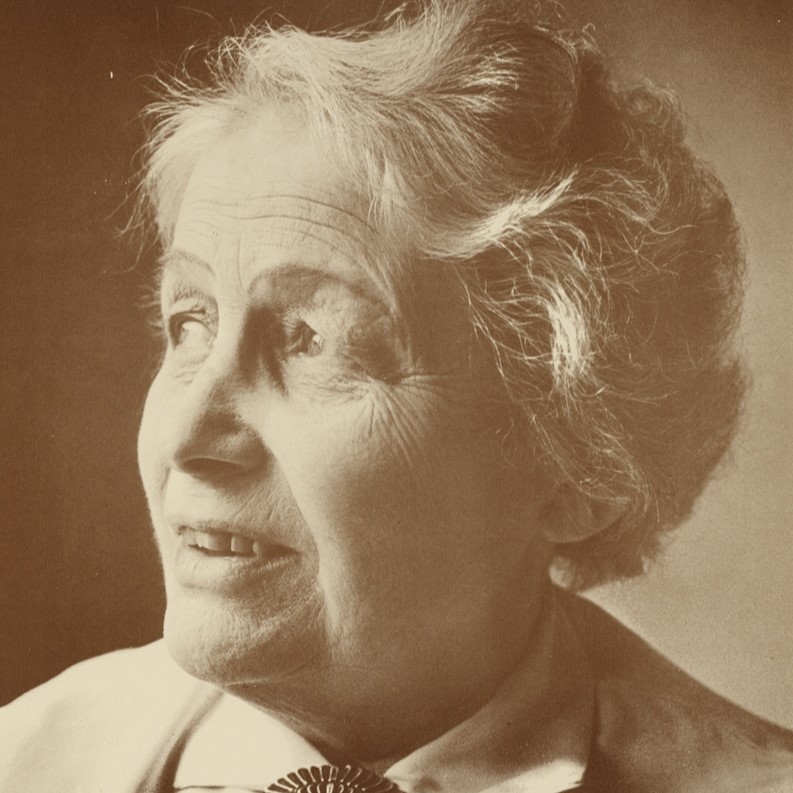
Annie Romein-Verschoor was a writer and historian.
Like her husband, Jan Romein, Annie Romein had Marxist sympathies. During World War II, Annie and Jan helped several people in hiding. They also participated in other forms of resistance work. Both were involved in the underground press, for example. Jan was imprisoned in Camp Amersfoort for several months in 1942. During this period, Annie was urged to join the 'Kultuurkamer' (Culture Chamber), which she refused on principle.[1] The Kultuurkamer was an institution established by the occupying forces, to which writers and journalists had to be affiliated in order to practice their profession.
In 1946, Annie obtained a copy of Anne Frank's diary, as Otto Frank was an acquaintance of hers. Otto Frank later stated that his friend Werner Cahn (to whom he had read the original manuscript and who worked at Querido publishers) had taken typescript II to Annie Romein-Verschoor without his knowledge. Annie remembered that Otto himself had given the manuscript to Annie.[2]
At that time, Annie was already known as a celebrated writer and had been awarded the Dr. Wijnaendts-Francken Prize. Annie helped Otto, initially unsuccessfully, find a publisher through her own contacts. She recommended the diary to Querido, the publishing house with whom she worked. Querido rejected the book, as they expected there would be no interest in war diaries so soon after the war.[1]
During this period, Otto also spoke with other acquaintances about his desire to publish the book. In such conversations, he also mentioned Annie Romein's help in this search.[3]
Annie shared the diary and the challenges of finding a publisher with her husband, Jan. Thanks in part to a column by Jan in newspaper Het Parool on the 3 April 1946, Otto finally found a publisher, Contact, for the book.[4] The Dutch version of The Diary of a Young Girld (Het Achterhuis) published in 1947 included a foreword written by Annie.
Correspondence between Otto and the Romeins was largely through Annie; for example, Otto addressed the first edition of Het Achterhuis primarily to her.[5]
Later in life, Annie wrote about the importance of remembering World War II and the accompanying racism. She also wrote about her own aversion to museums that emerged from the restoration of relevant sites, such as the Auschwitz-Birkenau State Museum and the Anne Frank House, which she personally prefered not to visit because they felt inauthentic to her.[1]
Source personal data.[6]
Footnotes
- a, b, c Annie Romein-Verschoor, Omzien in verwondering II, Amsterdam: Singel Uitgevers, 1971.
- ^ Anne Frank Stichting (AFS), Anne Frank Collectie (AFC), Otto Frank Archief (OFA), reg. code OFA_070: Bitte schreiben Sie mir etwas über Anne Frank, p. 8. Werner Cahn beweerde hetzelfde. Zie: NIOD, archief 257d, De dagboeken van Anne Frank, inv. no. 1i: Gespreksverslag Werner Cahn. Jan Romein herinnerde zich later dat Otto Frank zelf het manuscript bij zijn vrouw bracht met het verzoek te bemiddelen bij het vinden van een uitgever. AFS, AFC, OFA, reg. code OFA_089. Annie Romein-Verschoor herinnerde zich dat Otto Frank zelf het dagboek bij haar bracht. Omzien in verwondering 2, p. 109.
- ^ AFS, Getuigenarchief, Getuigeninterview Mozes Max van Kreveld door Dineke Stam, 5 december 1995.
- ^ AFS, AFC, OFA_89.2, Tekst van een interview met Jan Romein betreffende zijn rol bij de uitgave van het dagboek van Anne Frank.
- ^ AFS, AFC, OFA, reg. code OFA_100.66, Correspondentie van Annie Romein-Verschoor met Otto Frank, 1947.
- ^ Stadsarchief Amsterdam, Dienst Bevolkingsregister, Archiefkaarten (toegangsnummer 30238): Archiefkaart Anna Helena Margaretha Verschoor; Wikipedia; Annie Romein Verschoor.